
Log in to the OVID platform for NHS databases

 Complete your in-depth literature search using OVID databases. To search the OVID databases you'll need to log in using your NHS OpenAthens.

Which databases can you search?

OVID is host to a range of specialist, research, healthcare databases, purchased for NHS users. You can search the AMED, Embase, Emcare, HMIC, Medline and Social Policy and Practice databases.

Not sure which database you need? Complete our etutorial Which NHS database do you need? for more help.

How to log in to the OVID platform

1. Find the OVID Link

Get quick access to the OVID platform by linking from our NHS Resources page If you work for North Staffs Combined Healthcare or GP practices in Staffordshire or CCGs in Staffordshire please click the relevant button to go to your page of resources.

NHS resources page on the health library website

2. Select your institution

Search for your OpenAthens institution.

  • Tip: Staff at UHNM can enter North Midlands to get the organisation name quickly
  • Tip: Staff working for Combined Healthcare, the GP practices or CCGs in Staffordshire can enter Staffordshire to get their organisation names quickly.

Select your organisation from the results list.

Institution selection box

3. Log in with you NHS OpenAthen username

Enter your NHS OpenAthens username / password into the login page and click Sign In.

NHS OpenAthens login box

4. Select the database

You are now logged into the OVID platform. Select the database you want to search. You can select one, more than one or all resources.

List of databases on the OVID platform that you can select

5. Execute your search

You can now run your search against the OVID database(s)
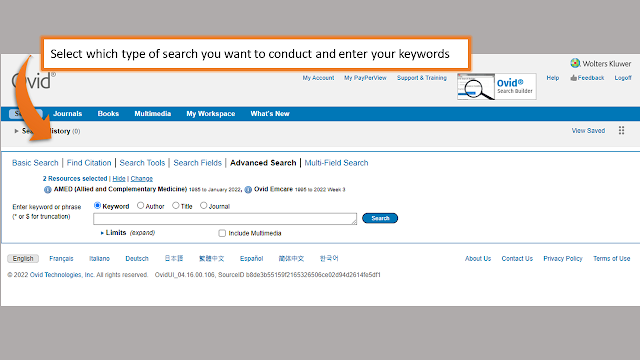
Search box on the OVID platform

More help

For help finding, accessing or searching NHS resources, please contact:

Comments

Popular posts from this blog

Hot topic! Hantavirus

 With the cruise ship in port and the travellers heading home the Hantavirus outbreak has been in the news recently. Learn more about this disease from library resources. Check these resources for an overview, key points, diagnosis, treatment options, follow-up and more. [You will need your NHS OpenAthens username to access these resources] BMJ Best Practice – Hantavirus cardiopulmonary syndrome Oxford Medicine Online – Hantavirus cardiopulmonary syndrome in Clinical Infectious Disease (3 rd ed) Selected articles from our journal collection Critical care management of hantavirus cardiopulmonary syndrome. A narrative review , Journal of Critical Care , Ulloa-Morrison, Rodrigo; Pavez, Nicolas; Parra, Esteban; Lopez, Rene; Mondaca, Roberto; Fernandez, Paula; Kraunik, David; Sanhueza, Claudia; Bravo, Sebastian; Cornu, Matias Germán; Kattan, Eduardo, Vol. 84, p. 154867, 2024. Hantavirus in humans: a review of clinical aspects and management , The Lancet Infectious Dis...

Hot Topic! Ebola

 News about the ebola virus continues, including this article from the BBC about healthcare workers Ebola outbreak: How health workers are treating patients and staying safe in DR Congo - BBC News Check these resources for an overview, key points, diagnosis, treatment options, follow-up and more. [You will need your NHS OpenAthens username to access these resources] BMJ Best Practice – Ebola disease Clinical Key (available to UHNM only) – Ebola Virus Disease Cochrane Library systematic reviews – Interventions to support the resilience and mental health of frontline health and social care professionals during and after a disease outbreak, epidemic or pandemic: a mixed methods systematic review (2020) Oxford Medicine Online – Chapter Emerging infectious diseases in Oxford textbook of health protection: principles and practice (2026) Patient Information Ebola [BMJ BP] Ebola virus infection: what to know [Clinical Key] Selected articles from our journal collection Combining v...

Article integrity checks for NHS staff

Want to have extra quality and integrity checks for the articles you find? Use library NHS resources and get warnings if the article you're reading fails integrity checks. NHS resources use LibKey to easily point you to subscribed resources. Now LibKey also does a number of integrity checks to help you feel confident with the articles you find. You’ll get warnings about: Retracted articles Retracted article citation (where an article includes references to articles which have been retracted) Expression of concern for the article (where publishers have concerns about some aspect of a published article) Problematic publishers information Warnings are presented at point of access whether from article links in databases or on the web via LibKey Nomad. Make sure you use library resources so that you are using LibKey links and integrity checks. For more help please contact the eresources librarian c.kent@keele.ac.uk