
Access TRIP Pro database from anywhere with your NHS OpenAthens username

 You can now search the TRIP Pro database and access additional content from anywhere. Log in with your NHS OpenAthens username to get Pro version content and functionality from home, university or work

TRIP is a medical database allowing you to search a wealth of high quality healthcare resources. You can focus search results by publication type to help you get to the information you need quickly.

Log in to TRIP database

Go to the TRIP database - you can access TRIP directly or click the link on our NHS Resources page. Click the login button on the home page [top right].
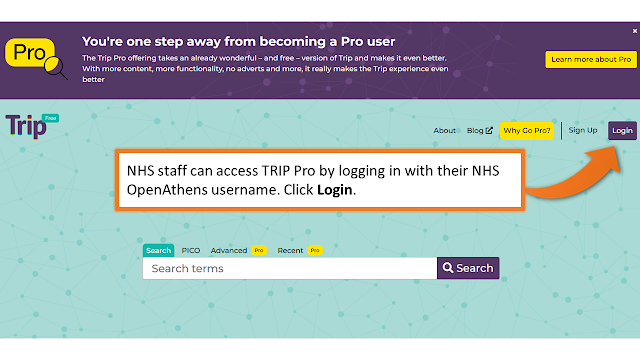
The TRIP database home page with the login button in the top right

Choose the Institution Login option to login via OpenAthens.
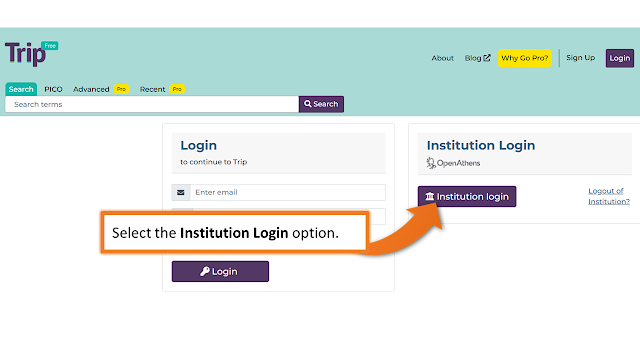
Choose the button Institution Login on the right-hand-side of the page

Select your organisation - you may need to search for your organisation. TRIP should remember the organisation you have chosen for next time you log in.

We support the following organisations:

  • University Hospitals of North Midlands (search for north midlands)
  • North Staffordshire Combined Healthcare (search for Staffordshire)
  • GPs, GP practice staff and CCG staff in Staffordshire (search for Staffordshire)
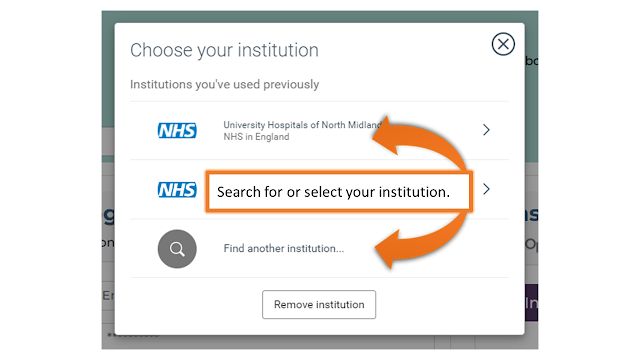
Search for your organisation

Enter your OpenAthens username / password
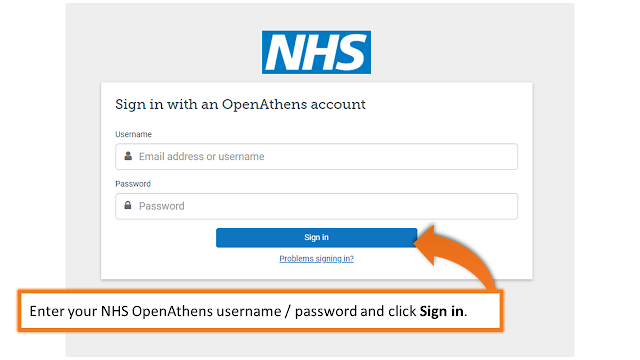
OpenAthens log in page - enter your openathens details

You are now logged in to the Pro version and can execute your search
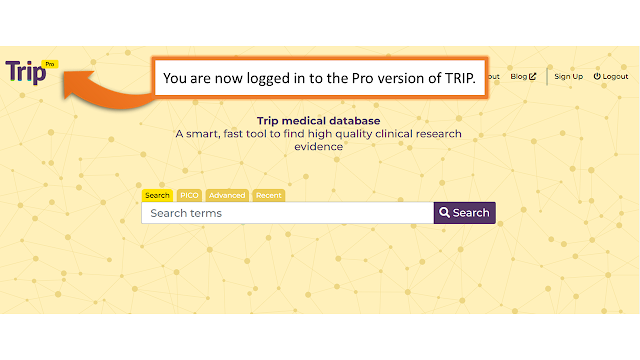
Search page showing the TRIP Pro logo

The Pro Version gives you access to more content and functionality.

List of Pro features
Advantages of using the Pro version include:

  • more full-text articles
  • medical images and videos
  • export function to reference management systems
  • advanced search options

Look out for the LibKey icon to check whether you have access to content returned in your search results.

LibKey icon next to the article will tell you whether you have access to full-text

More Help

Check our TRIP database help page or just ask.


Comments

Popular posts from this blog

Access the big 4 medical journals for free

  Get articles on key, major trials and practice changing news. You can access the big 4 key journals for free. What are the big 4 medical journals? The big 4 medical journals are: BMJ (British Medical Journal) The Lancet NEJM (New England Journal of Medicine) JAMA (Journal of the American Medical Association) How do you access the big 4 journals? NHS staff can access all 4 journals online using the same username / password – your NHS OpenAthens username / password. Not sure what an OpenAthens username is? Complete our etutorial. Get your OpenAthens username by completing the online form . Keele University staff and students get automatic access on campus but will need to use their email address and password to log in when off-campus. Where can you access the big 4 journals from? Our journal collections are not necessarily available from the publishers’ websites. NHS staff can browse our journal collections on Browzine. Whereas Keele University staff...

Introduction to Referencing and Plagiarism

What is the point of referencing? Why does everyone make such a big deal about it? What is plagiarism and how serious is it really? When you start to complete your literature searches you must also start your referencing process. Complete our etutorial Introduction to Referencing and Plagiarism to learn: What is referencing and why does it matter? What is plagiarism and how can you avoid it? What do you need to create a reference?

BMJ Case Reports from UHNM staff

 BMJ Case Reports is available to UHNM staff both to view full-text and to submit your own case reports. There have been 2 recent case reports submitted by UHNM staff: Penetrating head trauma unbeknown to the patient David Bristow and Shayda Karimi Abstract Penetrating head trauma often leads to significant morbidity or mortality. A man presented to our tertiary centre with concerns of a nail in his brain after work colleagues reviewed closed-circuit television footage which appeared to show a pneumatic nail gun discharging against his head during an incident at work 4 days earlier. Remarkably, the patient reported no symptoms and no clinical signs apart from a small scabbed area on his scalp. A CT scan of his head was performed which showed a 4 cm nail lodged within the parietal lobe of his brain. The patient subsequently underwent a craniotomy with removal of the nail along with antimicrobial cover with antibiotics and tetanus prophylaxis. The patient made a full recovery and was...