
Acta Cytologica Login Instructions

Acta Cytologica is an NHS-subscribed journal, available via OpenAthens username / password.

To Login:

1. Find the journal entry on the NHS A-Z journals list. You can find instructions on how to do this here.

2. Select the link for the online journal.
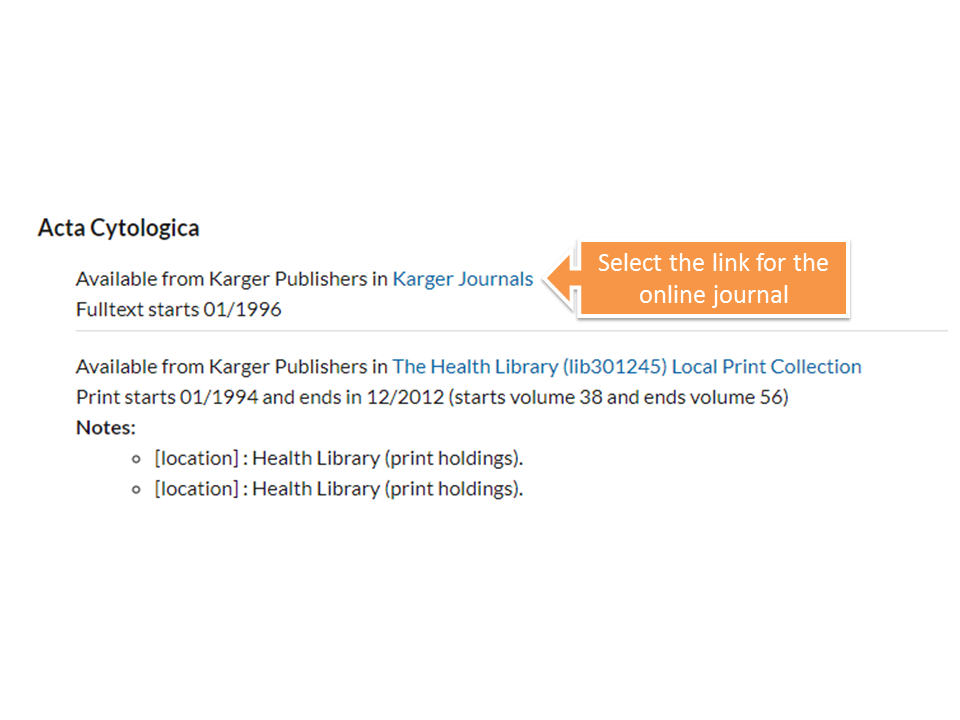
Screen-shot of the journal entry in the NHS A-Z journals list

3. This link will take you to the publisher’s page.
Screen-shot of the journal page for Acta Cytologica


4. Find the article you are looking for – you can use the “Year” drop-down link or page-down to see recent issues or the archive.
Screen-shot of the options to view previous issues of Acta Cytologica


5. Once you have found the article you want you may need to login to view the full-text. Use the “Login” link at the top of the page.
Screen-shot showing the full-text is not automatically presented


6. Select the OpenAthens login option.
Screen-shot showing the different login options to this website


7. Then enter “NHS England” into the organisation box and click search.
Screen-shot of the organisation search box


8. From the results list, select the option for “NHS England”.
Screen-shot showing the list of organisations returned by the search


9. You may then be prompted to log in via Athens – use you Athens username / password – or you may then be logged in automatically. You’ll be returned to the article page you were looking at. You can now use the fulltext or pdf options to view the fulltext.
Screen-shot showing that the user has logged in


10. The full-text will be presented.
Screen-shot of the full-text of this example article


Comments

Popular posts from this blog

Clinical Key training in October 2026

 Clinical Key is a search tool providing access to wide range of content from articles, journals and ebooks to clinical overviews, patient education and drug reference texts. It is available to UHNM staff via OpenAthens login . Elsevier are offering 2 training sessions during October. Topics covered in the session include:  What is ClinicalKey? Use cases and types of content.  Benefits of registration: 24/7 access, content downloads, and personalized alerts.  Live demonstration: efficient searching, navigation, and time-saving tools.  ClinicalKey App: access from iOS and Android devices.  Additional resources: video tutorials and reference materials.  Questions and answers. Please book your session online: October 20 – 12:00 GMT  Register here for session via MS Teams October 21 – 8:00 GMT  Register here for session via Zoom For more help using Clinical Key complete our online tutorial Get Started with Clinical Key .

Login to Library Search – step-by-step instructions for NHS staff

  Library Search is a discovery tool, allowing you to find items within the library collections. You can search Library Search without logging in to view books and ebooks available in our collections. By logging in to your library account on Library Search you can access a range of additional functionality, such as: Viewing details of your library account Submitting a request to hold a book for you Adding items to your e-bookshelf Saving searches Note that for NHS users logging in to Library Search does not give you access to full-text items. As an NHS member of staff you access online resources using your NHS OpenAthens username. Anatomy of a Library Card First let’s take a quick look at the most important components of your library card. Your library card and library card number give you access to print resources as well as library services. They confirm that you are a member of the library. Your name : this will be printed on your card, so you’ll know it’s yours!...

Updates to BMJ Best Practice topics

 The following important updates have been made to BMJ Best Practice topics. NICE recommends teplizumab to delay progression to stage 3 type 1 diabetes Topic: Type 1 diabetes , Section: Management: emerging The National Institute for Health and Care Excellence (NICE) in the UK now recommends teplizumab as an option for delaying the onset of stage 3 type 1 diabetes in adults and children aged 8 years and over with stage 2 type 1 diabetes. Previously, there were no treatments available to delay progression to stage 3 disease, and management was limited to monitoring, education, and psychosocial support. European guidance lowers the bar for starting antiviral therapy in chronic HBV Topic: Hepatitis B , Section: Management: approach The European Association for the Study of the Liver (EASL) has published its updated clinical practice guideline on the management of hepatitis B virus (HBV) infection. Recommendations for when to start antiviral therapy have been updated to make sure patie...