Finding NHS eJournals – quick step-by-step


Here are some quick step-by-step instructions on how to find whether you have access to the full-text of an ejournals.

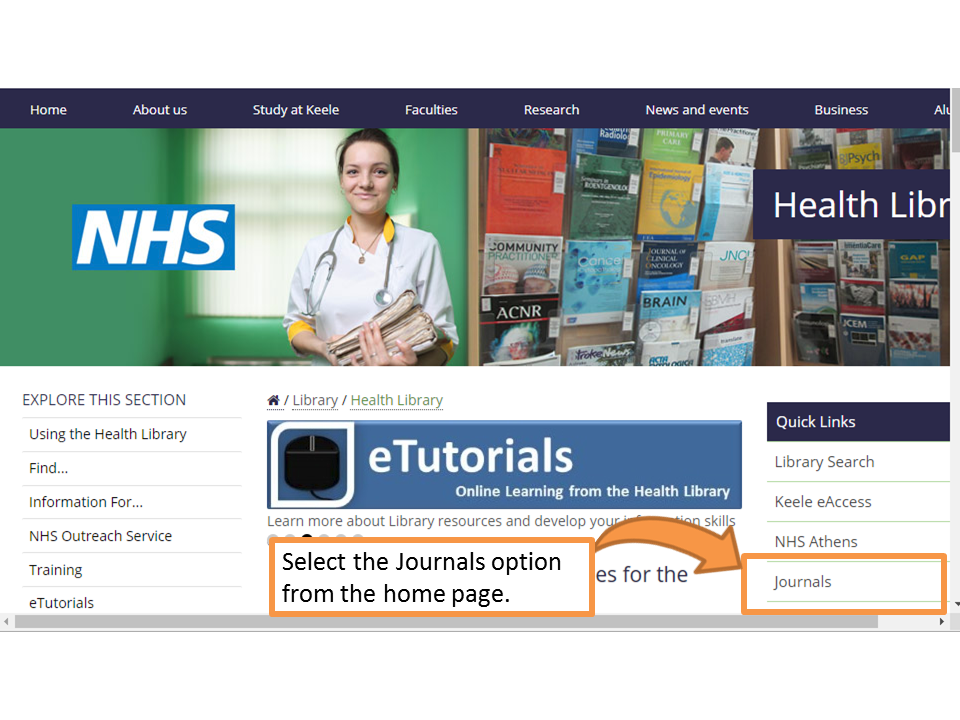
1. Start at the Health Library home page

Screen-shot of the Health Library home page

 
2. Click on the Journals option on the right-hand quick links list

Screen-shot of the Health Library home page

3. Select the “NHS Journals” option on the Journals page

Screen-shot of the Health Library's journals page

4. Enter your NHS Athens username / password when prompted and click the “Sign on” button

Screen-shot of the Athens login page


5. Enter the Journal Title that you want to check; select the search option (I’d recommend “Start of title”)

Screen-shot of the journal search page


6. Click the search button to run your search

Screen-shot of the journal search page


7. You’ll then be able to see a journal entry if you have access to this title. You need to check whether the holdings cover the year / volume / issue for the article you are looking for. In this example:

  • One entry has an embargo
  • One entry includes the current subscription
  • One entry details the print journal holdings

Clicking the link next to the entry will take you to the website where you can access this title, for the listed holdings. Note that you may have to log in to Athens again on the provider’s website.
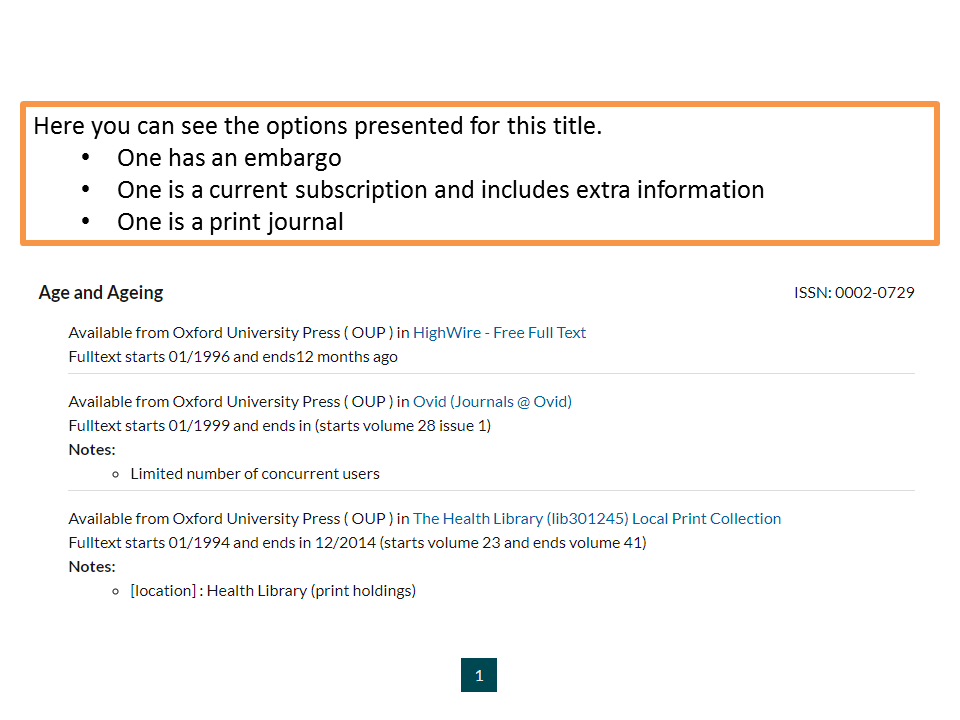
Screen-shot of a journal entry


Comments

Popular posts from this blog

Hot topic! Hantavirus

 With the cruise ship in port and the travellers heading home the Hantavirus outbreak has been in the news recently. Learn more about this disease from library resources. Check these resources for an overview, key points, diagnosis, treatment options, follow-up and more. [You will need your NHS OpenAthens username to access these resources] BMJ Best Practice – Hantavirus cardiopulmonary syndrome Oxford Medicine Online – Hantavirus cardiopulmonary syndrome in Clinical Infectious Disease (3 rd ed) Selected articles from our journal collection Critical care management of hantavirus cardiopulmonary syndrome. A narrative review , Journal of Critical Care , Ulloa-Morrison, Rodrigo; Pavez, Nicolas; Parra, Esteban; Lopez, Rene; Mondaca, Roberto; Fernandez, Paula; Kraunik, David; Sanhueza, Claudia; Bravo, Sebastian; Cornu, Matias Germán; Kattan, Eduardo, Vol. 84, p. 154867, 2024. Hantavirus in humans: a review of clinical aspects and management , The Lancet Infectious Dis...

Article integrity checks for NHS staff

Want to have extra quality and integrity checks for the articles you find? Use library NHS resources and get warnings if the article you're reading fails integrity checks. NHS resources use LibKey to easily point you to subscribed resources. Now LibKey also does a number of integrity checks to help you feel confident with the articles you find. You’ll get warnings about: Retracted articles Retracted article citation (where an article includes references to articles which have been retracted) Expression of concern for the article (where publishers have concerns about some aspect of a published article) Problematic publishers information Warnings are presented at point of access whether from article links in databases or on the web via LibKey Nomad. Make sure you use library resources so that you are using LibKey links and integrity checks. For more help please contact the eresources librarian c.kent@keele.ac.uk

Login to Library Search – step-by-step instructions for NHS staff

  Library Search is a discovery tool, allowing you to find items within the library collections. You can search Library Search without logging in to view books and ebooks available in our collections. By logging in to your library account on Library Search you can access a range of additional functionality, such as: Viewing details of your library account Submitting a request to hold a book for you Adding items to your e-bookshelf Saving searches Note that for NHS users logging in to Library Search does not give you access to full-text items. As an NHS member of staff you access online resources using your NHS OpenAthens username. Anatomy of a Library Card First let’s take a quick look at the most important components of your library card. Your library card and library card number give you access to print resources as well as library services. They confirm that you are a member of the library. Your name : this will be printed on your card, so you’ll know it’s yours!...