Clearing the Internet Cache in the Chrome Browser

You may find that you are asked to clear the Internet cache in your Internet browser if the web pages are behaving erratically. This will clear some of the data held by your browser and help to "reset" your browser.

Here are some basic instructions to clear the browser cache.

1. Open Chrome and select the ellipsis or "hamburger" menu option in the top right-hand corner.
Screen-shot of the Chrome browser

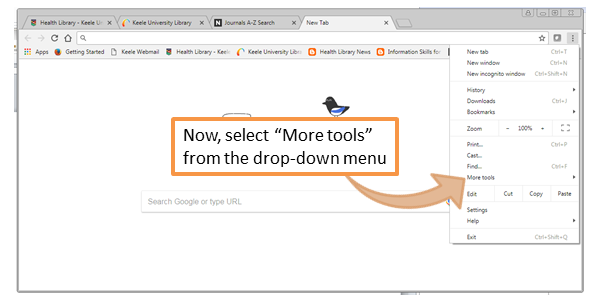
2. Now select the "More tools" option from the drop-down menu.

Screen-shot of the Chrome menu


3. From the next menu list, select the "Clear browsing data" option.

Screen-shot of the tools sub-menu

4. On the pop-up box, tick the options "Cookies and other site data" and "Cache images and files"; and finally click the "Clear Data" button.

Screen-shot of the "Clear browsing data" pop-up box

You can usually find instructions for clearing the cache of the most popular browsers via a search on the Internet.

Comments

Popular posts from this blog

Paediatric journal titles to support UHNM staff

 Here at the Health Library, we have extended our current awareness service to include journal table of contents updates straight to your inbox. UHNM staff working in paediatrics can stay up-to-date with the latest research and get the latest issue of your favourite paediatric journal title when it is published. Our paediatric titles include: Journal Of Pediatric Surgery Nursing Children And Young People Paediatrics And Child Health Pediatric Clinics Of North America Pediatric Critical Care Medicine Pediatric Infectious Disease Journal Pediatrics Here are some example articles: Post-extraction management of esophageal button battery injuries in children: A scoping review of imaging, ICU admission, and NPO practices , Journal of Pediatric Surgery, Clinker, Christopher; Alvey, Brighton; Reynolds, Elizabeth; Wieck, Minna, Vol. 61 Issue 7, p. 163066, 2026. Damp and mould: improving the health and homes of children with asthma through NHS and local authority collabor...

Optimize your use of Clinical Key - training opportunity from elsevier

 UHNM subscribes to ClinicalKey — the tool that gives you full-text access to the most relevant medical resources to support you in your daily work. Experience the platform and its key features during upcoming online sessions, delivered by elsevier. In this 45-minute training for ClinicalKey.com , you will: Discover what ClinicalKey is and how it supports your clinical decisions. Learn the benefits of registering: 24/7 access, content downloads, and personalized alerts. See a live demonstration of efficient searching, navigation, and time-saving tools. Explore the ClinicalKey App for access on any device. Access extra resources like video tutorials and reference materials. Click on the session most convenient for you to register for the ms teams session: Wednesday 22nd April 10am Wednesday 27th May 10am Wednesday 24th June 10am Get started with Clinical Key by completing the online tutorial from the Health Library for the basic features and video demonstrations.

Introducing a New Reading Experience in Clinical Key

  Clinical Key is a clinical search engine provided for our UHNM users only. Reading Assistant – a new feature from Clinical Key Clinical Key is adding a Reading Assistant, an integrated generative AI feature designed to help you quickly comprehend and navigate complex clinical content. This enhancement uses structured summarisation and inline clarification to present key insights from book chapters and journal articles, all while keeping the original expert-authored content fully visible and authoritative. What the Reading Assistant Provides Concise, structured summaries of the content currently on the page Clarification of complex concepts without changing the underlying evidence Faster navigation through long chapters and dense journal articles Reduced cognitive load when approaching complex or lengthy material How It Works — Designed for Clinical Reliability The Reading Assistant has been built with a strong emphasis on safety, privacy, and the integrity of evidence...